steroidnpeptides

03 · GHRH SIDE OF THE AXIS · THE APPROVED ONE

Tesamorelin: research overview

The one compound here that was taken all the way through a development programme — and the narrow, specific indication that programme actually earned.

The short version

Tesamorelin (Egrifta) is a synthetic copy of the full 44-amino-acid growth-hormone-releasing hormone, the brain's own signal to the pituitary gland, with a chemical group attached to one end so that blood enzymes cannot destroy it as quickly.

It is the only compound on this desk with an approved medical use. In 2010 it was licensed in the United States to reduce excess abdominal fat in people with HIV who had developed lipodystrophy — a redistribution of body fat associated with antiretroviral therapy [14]. That is the whole of the licence. Every other application is off-label and investigational.

What the trials measured was visceral adipose tissue: the deep abdominal fat that wraps around the organs, quantified in square centimetres on a CT scan. Pooled across five randomised controlled trials, tesamorelin reduced it by 27.71 square centimetres, reduced liver fat, and increased lean mass, all with a p-value below 0.001 and without serious adverse events [13].

The fat comes back when treatment stops [17]. That is not a footnote; it is central to reading the compound honestly.

What it is

Tesamorelin is a synthetic 44-amino-acid analogue of human growth-hormone-releasing hormone, GHRH(1-44)-NH2, carrying a trans-3-hexenoic acid group conjugated to the N-terminus. That modification confers resistance to cleavage by dipeptidyl peptidase-IV and extends plasma stability relative to the native hormone. The free base has the empirical formula C221H366N72O67S; the clinical product is supplied as the acetate salt. In the development literature it appears as TH9507.

It reached the United States market in November 2010 under new drug application 022505, indicated to reduce excess abdominal fat in HIV-infected adults with lipodystrophy [14]. No indication exists outside that population. General visceral-fat reduction, anti-ageing use, cognitive applications and non-HIV fatty liver disease are all off-label and investigational.

Because the approved article exists, this is also the one compound on the desk where the distinction between pharmaceutical and research-grade material is concrete rather than theoretical. The approved product is manufactured, tested and released under pharmaceutical quality systems for its licensed indication; research-grade material sold under the same name carries none of those assurances.

What it is

How it works

Tesamorelin binds the growth-hormone-releasing hormone receptor on anterior-pituitary somatotroph cells, activating the Gs-coupled adenylyl cyclase cascade through cAMP and protein kinase A and stimulating both synthesis and pulsatile secretion of the body's own growth hormone. That growth hormone drives hepatic production of insulin-like growth factor 1, and together the two promote lipolysis with a marked preference for visceral adipose tissue over subcutaneous fat.

The mechanistic point that distinguishes it from recombinant growth hormone is the word pulsatile. Tesamorelin amplifies an existing rhythm rather than supplying a hormone from outside, and the metabolic consequences of the two approaches are not the same. Recombinant growth hormone reliably degrades glucose handling; tesamorelin's record on that front is notably cleaner. In 13 healthy men, two weeks of 2 mg daily raised mean overnight growth hormone by 0.5 micrograms per litre (p=0.004) and IGF-1 by 181 micrograms per litre (p<0.0001), while fasting glucose (p=0.93) and insulin-stimulated glucose uptake (p=0.61) were both unaffected [16].

The receptor is shared with CJC-1295, and the engineering problem each solves is identical — surviving dipeptidyl peptidase-IV. Tesamorelin solves it with an N-terminal acyl group; CJC-1295 solves it with internal substitutions plus, in its long-acting form, an albumin tether [12]. The two arrive at different durations by different chemistry.

What the research shows

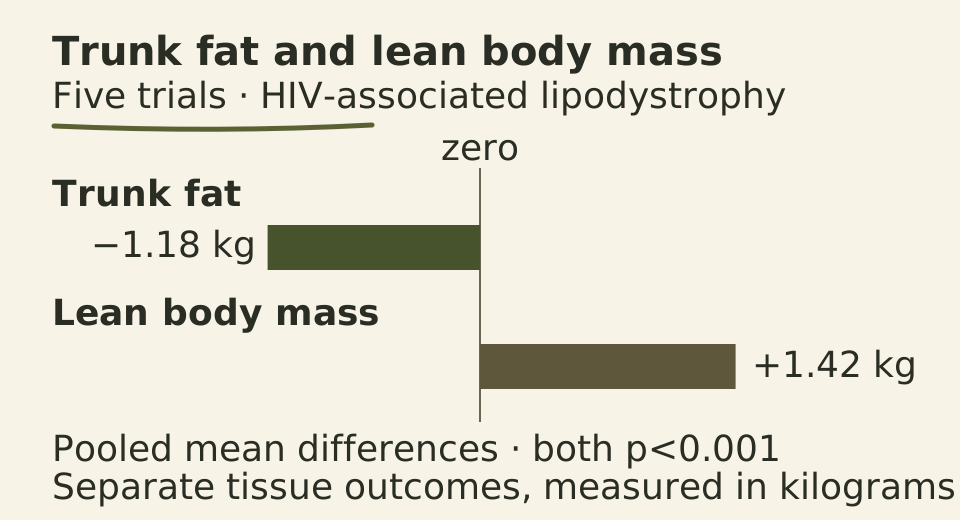
The pooled randomised evidence. A 2026 meta-analysis of five randomised controlled trials in HIV-associated lipodystrophy found that tesamorelin reduced visceral adipose tissue by a mean difference of 27.71 square centimetres (95% confidence interval -38.37 to -17.06; p<0.001), reduced trunk fat by 1.18 kilograms and hepatic fat fraction by 4.28 percentage points, and increased lean body mass by 1.42 kilograms — all at p<0.001, and without serious adverse events [13]. This is the strongest single body of evidence anywhere on this desk.

The liver signal, measured directly. A six-month randomised controlled trial published in JAMA enrolled 50 antiretroviral-treated adults with HIV, 28 on tesamorelin 2 mg daily and 22 on placebo. The treatment effect on visceral fat was -42 square centimetres (p=0.005), and the hepatic lipid-to-water percentage fell by a net 2.9 percentage points (p=0.003) [15].

Durability, and its limit. In the 52-week programme — tesamorelin 2 mg daily in 273 participants against placebo in 137 — the visceral-fat reduction was sustained at 18% over 52 weeks (p<0.001 against baseline), and changes in glucose parameters over that year were not clinically significant. Visceral fat reaccumulated on discontinuation [17]. The benefit is contingent on continued treatment, which is a straightforward statement of what the trial found.

Endocrine and metabolic profile in healthy volunteers. Two weeks of 2 mg daily in 13 healthy men raised mean overnight growth hormone by 0.5 micrograms per litre (p=0.004) and IGF-1 by 181 micrograms per litre (p<0.0001), with fasting glucose (p=0.93) and insulin-stimulated glucose uptake (p=0.61) unchanged [16]. This is the only study on the desk that measured the growth hormone axis in healthy people and looked at insulin sensitivity at the same time.

Hepatic safety. The National Institutes of Health LiverTox monograph assigns tesamorelin a likelihood score of E — unlikely to cause clinically apparent liver injury — noting no reported attributable cases of liver injury and no de novo serum enzyme elevations in trials [14].

Reported effects, cautions and safety

The other two pages on this desk carry a block of community-reported effects labelled anecdotal, not clinical evidence. This page does not, because the corpus behind the site records no such signal set for tesamorelin and nothing is invented here to fill the gap. The absence is itself informative: tesamorelin is the compound with a licence, a prescriber and a defined patient population, so what is known about how it feels to take comes from case report forms rather than from forums.

What the trials found. No serious adverse events were reported across the five pooled randomised controlled trials [13]. Liver injury is unlikely on the available record, with no attributable cases and no de novo enzyme elevations [14]. Glucose parameters did not change to a clinically significant degree over 52 weeks [17], and neither fasting glucose nor insulin-stimulated glucose uptake shifted significantly over two weeks in healthy men [16]. For a growth-hormone-axis agent, that is a comparatively reassuring metabolic picture, and it is the strongest argument that amplifying an endogenous pulse is not equivalent to administering the hormone directly.

Cautions grounded in the record. The approval covers HIV-associated lipodystrophy and nothing else. The pivotal trials enrolled HIV-positive adults on antiretroviral therapy, so generalisation to other populations is mechanistically plausible but has not been established by large randomised trials — a distinction that most off-label discussion collapses.

Visceral fat reaccumulates within weeks of stopping [17]. Any account of the compound that omits this is describing a different drug from the one that was studied.

Growth-hormone-axis stimulation raises IGF-1, a growth factor. Trials showed no excess malignancy signal over 52 weeks, but long-term oncologic safety data are limited and active malignancy is a labelled contraindication. Modest glucose perturbation can occur even though the aggregate data are reassuring, which matters most for anyone whose glucose handling is already impaired.

Cognitive findings are mixed rather than positive: a trial in a non-HIV ageing population showed an executive-function benefit, while a 2025 trial in HIV cognition did not show significant neurocognitive improvement over standard care. Both results belong in any honest summary.

Tesamorelin is prohibited in sport at all times under category S2 of the World Anti-Doping Agency list, in and out of competition, as a growth-hormone-releasing hormone analogue. High pharmaceutical cost and injection-only administration limit access to the approved product, and research-grade material sold for laboratory use lacks the purity and potency oversight that product carries.

Where it fits in the growth hormone axis

Tesamorelin is the benchmark on this desk, and it earns that position by being the only compound here that was carried through a complete development programme to a regulator's decision.

It is worth being precise about what that programme proved. It proved that daily treatment reduces a specific depot of deep abdominal fat, measured in square centimetres on a scan, in adults with a specific fat-redistribution syndrome, and that the effect disappears when treatment stops [13][17]. It did not prove anything about muscle in healthy trained adults, about strength, or about ageing. The lean-mass figure that circulates online — 1.42 kilograms — is a pooled result in a population being treated for lipodystrophy [13], not an outcome from a training study, and there is no training study.

That is the clearest available demonstration of the gap this desk exists to describe. Tesamorelin has the strongest evidence base of the three compounds here, and even that evidence base answers a question almost nobody arriving from a performance-oriented search was asking. It measured visceral fat in a wasting-adjacent clinical syndrome. Against that, ipamorelin's record is one failed trial and a set of animal experiments [3][5], and CJC-1295's is a handful of hormone-concentration studies [9][10]. The three compounds are not variations on one product; they are three very different distances from a proven claim.